Warranties
 Rebates
 Tax Credits
 Sustainability
 Careers
 Help


What Drives the Cost of a New HVAC System
November 12, 2026
 Facebook
 X
 LinkedIn
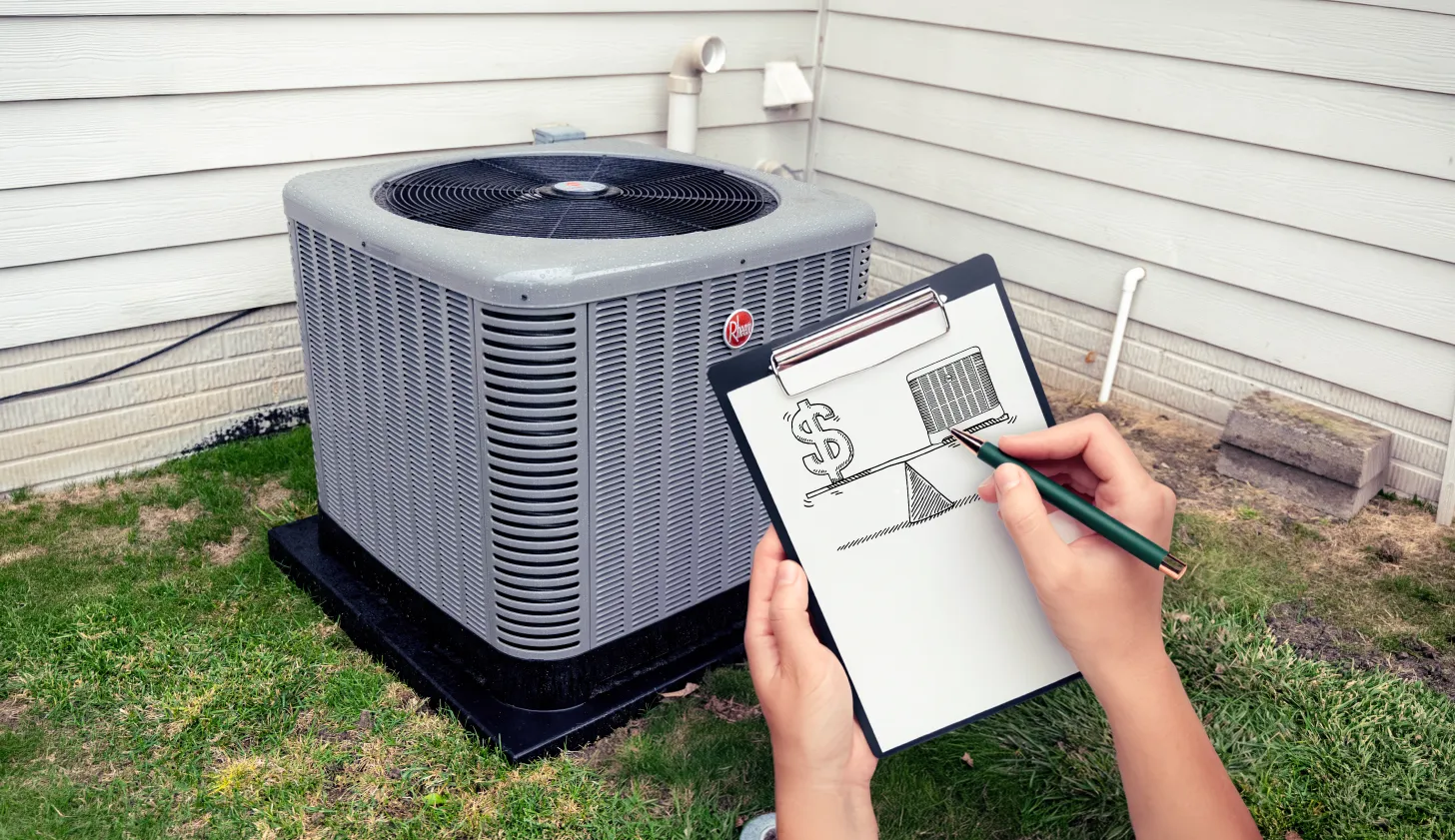
With any home investment, cost is usually top of mind. But several factors impact the final total of a new HVAC system.
The truth is that the cost of a new HVAC system is set by your house. Two homes on the same street can get HVAC replacement cost quotes that sit far apart, and both quotes can be fair.
Six factors influence the cost more than anything else: capacity, efficiency tier, refrigerant, ductwork condition, labor, and permits.
Once you know those six, any quote gets easier to read. And if your current system still runs, start with Rheem’s guide on when to repair or replace your HVAC system.
How much does it cost to replace an HVAC system?
KEY TAKEAWAYS: The cost to replace an HVAC system depends on six drivers: capacity, efficiency tier, refrigerant, ductwork, labor, and permits. A national average HVAC replacement cost blends very different homes and fits almost none of them. An in-home load calculation and an itemized quote give the only reliable number for a specific house.
There isn’t one specific price for an HVAC system. Anyone who gives you one without seeing your house is guessing.
National averages get quoted everywhere. To come up with those numbers, they might mix a 1,200-square-foot condo in Phoenix with a drafty 1920s two-story in Minneapolis, then split the difference. That blended figure is too high for some homes and much too low for others.
Instead, it’s more accurate to look at the factors that drive costs. Every quote is built from the same handful of decisions, and each one pushes the total up or down.
Capacity is how much heating or cooling the house needs. Efficiency tier is how little energy the system uses to deliver it. The refrigerant in HVAC equipment also makes a difference, and the recent industry transition to A2L refrigerant changed what’s inside.
Ductwork, labor, and permits cover everything that isn’t the box itself. That’s where most surprises live.
A good contractor will walk you through each of these line by line. If a quote won’t break them out, take that as a red flag.
What makes one air conditioner cost more than another?
KEY TAKEAWAYS: Capacity, efficiency tier, and compressor staging make one air conditioner cost more than another. A larger or higher-SEER2 air conditioner costs more upfront but can cost less to run. Replacing the matched indoor coil also changes the final new AC unit cost.
Two air conditioners can look identical and still carry very different price tags. Three things explain most of the gap.
Capacity and the load
Air conditioners are sized in tons. One ton moves 12,000 BTUs of heat per hour, and a bigger house in a hotter climate needs more tons.
Bigger isn’t better, though. An oversized unit can cool the air fast but shut off and leave the house clammy because it never runs long enough to pull the humidity from the air.
The solution is a proper load calculation. Air Conditioning Contractors of America (ACCA)’s Manual J residential load calculation looks at insulation, windows, orientation, and air leaks instead of square footage alone. If a contractor sizes your system by rule of thumb, ask why.
Efficiency tier and staging
HVAC equipment receives ratings that indicate how every single unit works and operates. SEER2 measures cooling efficiency. There are different efficiency tiers, and generally, a higher SEER2 rating indicates a more efficient air conditioning system. Higher tiers use larger coils and smarter motors, and that hardware costs more to build.
Staging matters, too. A single-stage compressor is either on or off. Two-stage and variable-speed units can run at partial speed for longer, quieter cycles, and steadier temperature and humidity control.
Want more information on system ratings? Rheem explains what each SEER2 and HSPF2 rating measures in a separate guide.
The matched system
HVAC systems generally include an outdoor AC unit and indoor air handler. Pairing a newer unit with an old, mismatched one can negatively impact efficiency.
That’s why many HVAC system quotes replace both halves, even if you only asked about the AC. You can see how Rheem pairs components across its current air conditioner lineup.
The cost drivers that live outside the equipment
There are several HVAC cost factors that go beyond the equipment itself, and this is where many estimates can differ. After all, the box is easy to compare. Everything around it isn’t.
Ductwork condition
Old ducts can quietly undercut a new system. ENERGY STAR estimates that 20% to 30% of the air moving through a typical duct system is lost to leaks, holes, and loose connections.
Sealing or resizing ducts adds to the quote. Skipping it means a high-efficiency unit pushes paid-for air into the attic.
No ducts at all? A ductless mini-split system can cost less than building ductwork from scratch. Rheem covers when a ductless install makes sense here.
Electrical and venting
Heat pumps and some high-efficiency units can need a new circuit or a panel upgrade, especially in older homes. Gas furnaces need correct venting, too.
Swapping an 80% AFUE furnace for a 95% condensing model usually means new PVC vent pipe and a condensate drain. That’s real labor, and it belongs on the quote.
Permits and inspections
Most cities and counties require a mechanical permit for a system replacement. Some add an electrical permit or a final inspection. Permit fees vary by jurisdiction.
Labor and access
Crawlspace installs, cramped attics, rooftop units, and long refrigerant line runs all take more crew hours. Hauling off old equipment and recovering its refrigerant takes time too.
Location matters as well. Labor rates in a big metro don’t match rates in a small town, even for the same job.
Is it cheaper to replace the AC and furnace together?
KEY TAKEAWAYS: Replacing the AC and furnace together usually costs less than two separate replacements years apart. One installation means one crew visit, one permit, and one round of equipment removal. A matched indoor and outdoor system also protects rated efficiency.
The cost to replace AC and furnace together is lower because bundling saves on the parts of the job that repeat. You pay for one crew trip, one permit cycle, and one haul-away instead of two.
It also avoids an efficiency mismatch. A new outdoor unit tied to a 15-year-old furnace often can’t hit its rated efficiency, and the old blower may not move enough air for it.
The case for splitting them is simple: Your furnace might have years left. A 6-year-old furnace in good shape doesn’t need to go just because the AC quit.
Ask for the quote both ways, so the gap is right in front of you.
If you’re looking at furnace replacement cost on its own, ask what changes if an air conditioner gets replaced, too. Bring the age of each unit to the visit, and see Rheem’s checklist for meeting with an HVAC contractor for other information and questions to ask.
Is a heat pump cheaper than a furnace?
KEY TAKEAWAYS: A heat pump is often cheaper to run than a furnace but may not be cheaper to buy and install. Heat pump cost depends on climate, electricity rates, and any electrical upgrades. A gas furnace still needs a separate air conditioner for cooling.
Compare the right two things. A heat pump replaces both a furnace and an AC, so the fair comparison is a heat pump against a furnace plus an AC.
Seen that way, the gap narrows. Against a furnace alone, the heat pump nearly always looks more expensive upfront.
Operating cost depends on local rates. Where electricity is cheap compared with natural gas, a heat pump tends to win on monthly bills. Where gas is cheap and winters run long, the furnace holds its ground.
Then there’s the panel. Moving from gas heat to electric heat can push an older 100-amp panel past its limit, and that upgrade lands on the heat pump side of the ledger.
Rheem’s furnace vs. heat pump guide covers climate fit and dual-fuel setups in depth. This post sticks to what moves the price.
Does HVAC installation cost more in winter?
KEY TAKEAWAYS: HVAC installation does not carry a winter surcharge by rule, but peak-season emergencies leave little room to compare quotes. Spring and fall are the slowest seasons for most HVAC contractors. A planned replacement almost always beats a forced one.
The equipment price doesn’t change with the thermometer. Demand does.
When a furnace dies on the coldest night in January, you call whoever can come tomorrow. There’s no time for three quotes, and after-hours rates may apply.
The same thing happens in a July heat wave. Crews are booked solid and the first available slot wins.
Spring and fall are the shoulder seasons. Crews have more open days, and you have time to compare.
If your system is aging, plan the swap for one of those windows. HVAC installation cost stays the same, but your bargaining power goes up a lot.
What should you compare when you get HVAC replacement quotes?
KEY TAKEAWAYS: Compare HVAC replacement quotes on model numbers, efficiency ratings, load calculation, ductwork scope, permits, and removal. Matching line items is what makes two quotes comparable. A lower total that drops ductwork or permits is not a lower price.
Get at least two quotes, three if you can. Then line them up side-by-side.
Totals tell you very little on their own. A quote that’s lower because it skips duct sealing or leaves out the permit isn’t cheaper. It’s just less work on paper.
Before the visit, jot down the age of your equipment and any comfort problems, like a bedroom that never cools off. Those details change what a good contractor recommends.
Ask for the scope in writing. A contractor who stands behind a price won’t mind putting it on paper. Check each quote for these:
-
-
- Exact model numbers for every part of the system, both indoor and outdoor
- SEER2, HSPF2 or AFUE rating on each unit
- Whether a thorough load calculation was done, and what it found
- Duct testing, sealing or changes, all spelled out
- Electrical work, including any panel upgrade
- Permit and inspection fees
- Removal of the old equipment and recovery of its refrigerant
- Who registers the new equipment, and when
-
Get a quote built for your house
Your HVAC replacement cost comes down to capacity, efficiency tier, refrigerant, ductwork, labor, and permits. An independent Rheem® Pro Partner® can measure each one in your home and give you a number you can actually plan around.
Frequently Asked Questions
How much does a new AC unit cost?
A new AC unit cost depends on tonnage, efficiency, compressor staging, and whether the indoor unit is replaced to match. Installation adds labor, refrigerant line work, electrical work, and permits. Air conditioner prices also rose after the 2025 move to A2L refrigerants such as R-454B. A contractor’s load calculation and itemized quote give the most accurate air conditioner price for a specific home.
What is the average furnace replacement cost?
Furnace replacement cost varies too widely by home for a single average to be useful. The biggest swings come from fuel type, AFUE efficiency rating, furnace capacity, venting changes, and ductwork condition. Moving from an 80% AFUE furnace to a 95% condensing furnace often requires new PVC venting and a condensate drain. An itemized in-home quote shows the true furnace replacement cost for a specific house.
How much does a heat pump cost compared to an AC and furnace?
Heat pump cost is best compared against an air conditioner and furnace together, because one heat pump handles both heating and cooling. Against a furnace alone, a heat pump usually costs more to install. Climate, local electricity rates, and electrical panel capacity decide whether heat pump operating savings offset the higher upfront price over the life of the system.
Does HVAC installation cost more in winter?
HVAC installation does not carry a winter surcharge by rule, but winter and summer are the busiest seasons for HVAC contractors. Emergency replacements during peak demand may include after-hours rates and leave little time to compare quotes. Spring and fall replacements usually offer more scheduling flexibility and more room to compare bids from several contractors.