Warranties
  Rebates
  Tax Credits
  Sustainability
  Careers
  Help
Help 



Understanding Common HVAC and Water Heating Unit Ratings
July 15, 2026
 Facebook
  X
X  LinkedIn
 If you’ve ever looked closely at your HVAC or water heating units, you may have noticed groupings of letters and numbers that look randomly slung together. Some of what you may see are actually HVAC and water heating unit ratings, which are important indicators of how every single heating, cooling, or water heating unit works and operates.
Here we’ll decode some of the common HVAC and water heating unit ratings, how they impact energy efficiency, and what they mean for your home.
What are HVAC and water heating unit ratings?
Every heating and cooling unit comes with specific ratings that measure performance, energy efficiency, heating and cooling capacity, and more. These ratings are an important tool that contractors and plumbers use to understand how each HVAC and water heating unit operates inside the home.
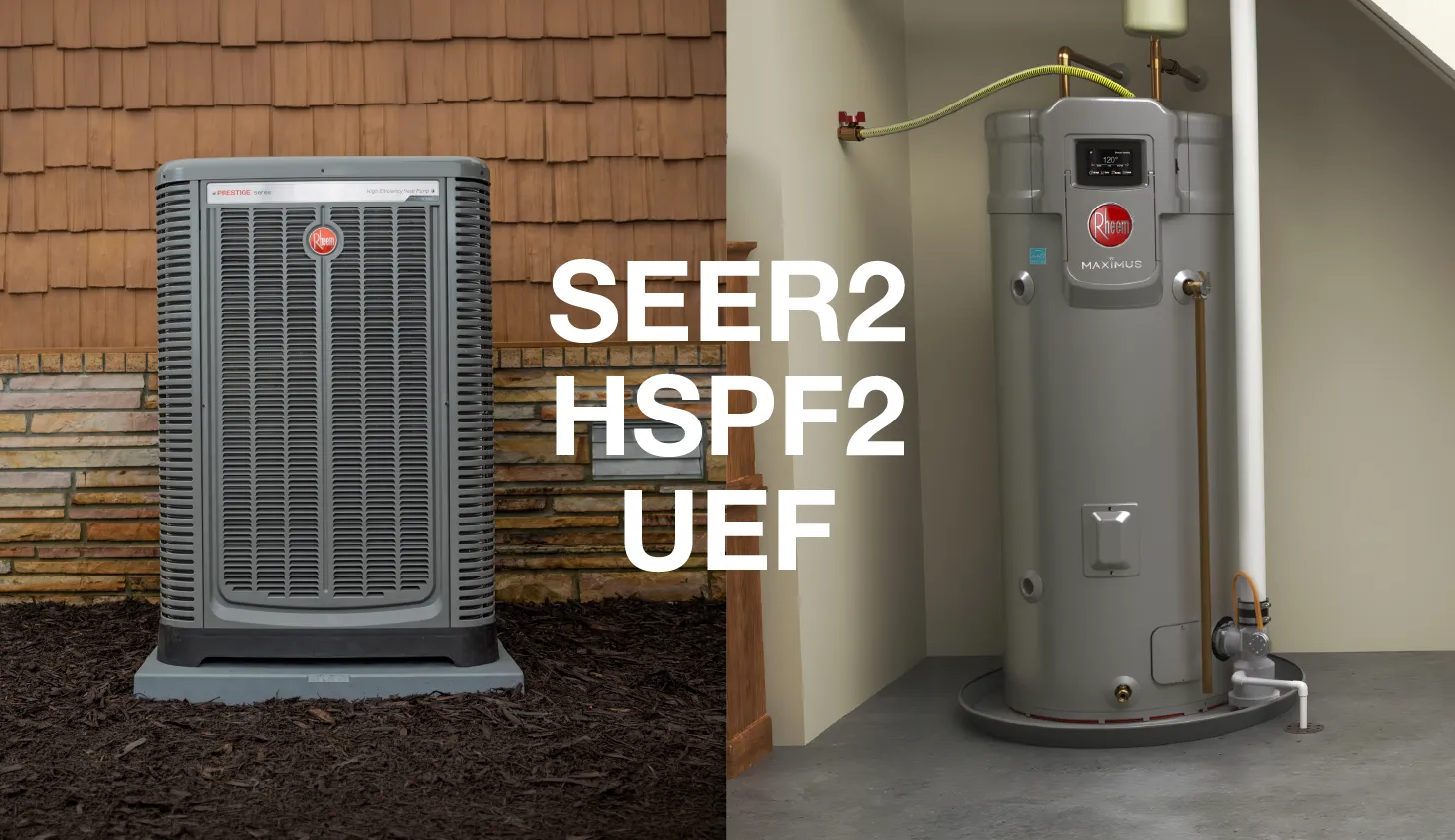
There are many different system ratings, but SEER2, HSPF2, and UEF are among the most common.
What do these ratings mean to homeowners?
These ratings can be a key indicator to how an HVAC or water heating unit will perform inside your home. The better the rating, the more efficient the unit. And the more efficient the unit, the more potential for lower energy and utility bills.
What is a SEER2 rating?
SEER2, or the seasonal energy efficiency ratio 2, is the national metric established by the Department of Energy (DOE) to measure the cooling efficiency of air conditioners and heat pumps. In recent years, SEER2 replaced SEER to provide a more accurate measure of energy efficiency.
A SEER2 rating is calculated by dividing the total cooling output of an HVAC system during a typical cooling season (in BTUs) by the total electrical energy it consumes (in watt-hours).
There are different efficiency tiers, and generally, a higher SEER2 rating indicates a more efficient air conditioning system, lower energy bills, and greater indoor comfort.
- Minimum Standard (13.4 to 14.3 SEER2): The legal minimum requirement depending on your region and system size.
- Mid-Efficiency (15 to 17 SEER2): A common SEER2 range for moderate climates, balancing upfront equipment costs with noticeable monthly energy savings.
- High-Efficiency (18 to 20 SEER2): Delivers drastically lower operating costs, highly advanced motors, and significantly quieter operation.
- Premium (21 to 24+ SEER2): Top-tier variable-speed systems that offer maximum home comfort and unmatched humidity control.
What is an HSPF2 rating?
HSPF2 stands for heating seasonal performance factor 2. Like SEER2, HSPF2 replaced the original HSPF rating. HSPF2 is the current Department of Energy (DOE) standard for measuring the heating efficiency of residential heat pumps.
A higher HSPF2 rating means the heat pump system generates more heat while using less electricity, which can directly reduce your energy bills. The DOE requires split-system heat pumps to have a minimum HSPF2 rating of 7.5. High-efficiency units can reach HSPF2 ratings of 13.0 or higher.
What is a UEF rating?
A water heater’s energy efficiency is determined by the uniform energy factor (UEF), which is based on how much energy the water heater uses during a representative day. The higher the UEF, the more efficient the water heater.
Water heaters are assigned into one of four different sizes (very small, low, medium, and high) of hot water usage, typically called bins, and are then evaluated for efficiency based on that usage. A water heater is assigned a UEF within its bin based upon its first hour rating for storage or maximum gallons per minute (Max GPM) for tankless.
A higher UEF means a water heater is more energy efficient and will cost less to operate compared to other water heaters in the same bin. A water heater’s UEF should only be compared with water heaters within the same bin.
Good UEF ratings can depend on the equipment and how much water your household uses:
- Heat Pump (Hybrid Electric): 3.0 to 4.0 UEF
- Electric Tank: 0.92+ UEF
- Tankless Gas: 0.90 to 0.95+ UEF
- Gas Storage Tank: 0.68+ UEF
The HVAC and Water Heating Ratings Best for Your Home
Every home is different, and every homeowner has different energy efficiency goals. Talking with a contractor or plumber can help you find the HVAC and water heating equipment best suited to meet both.
Find a trusted Rheem® Pro Partner® contractor or plumber in your area to get started today.