Warranties
 Rebates
 Tax Credits
 Sustainability
 Careers
 Help


Rheem® STID Series Indirect Tanks vs. Rheem® STB Series Buffer Tanks: What’s the Difference?
October 27, 2026
 Facebook
 X
 LinkedIn
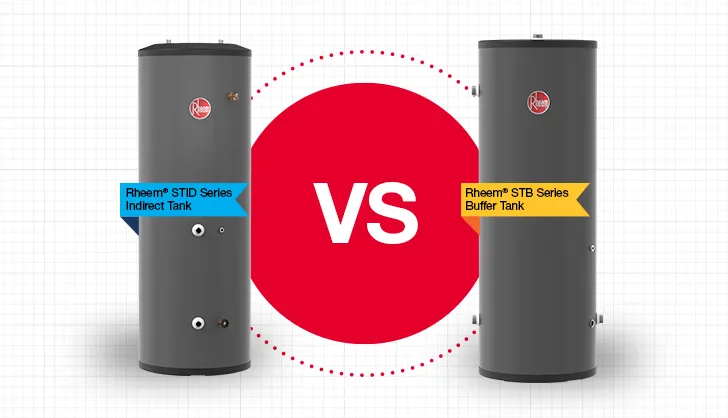
When designing a hydronic heating system, it’s important to understand the difference between an indirect water heater and a buffer tank. While both are installed alongside boilers, they serve very different purposes.
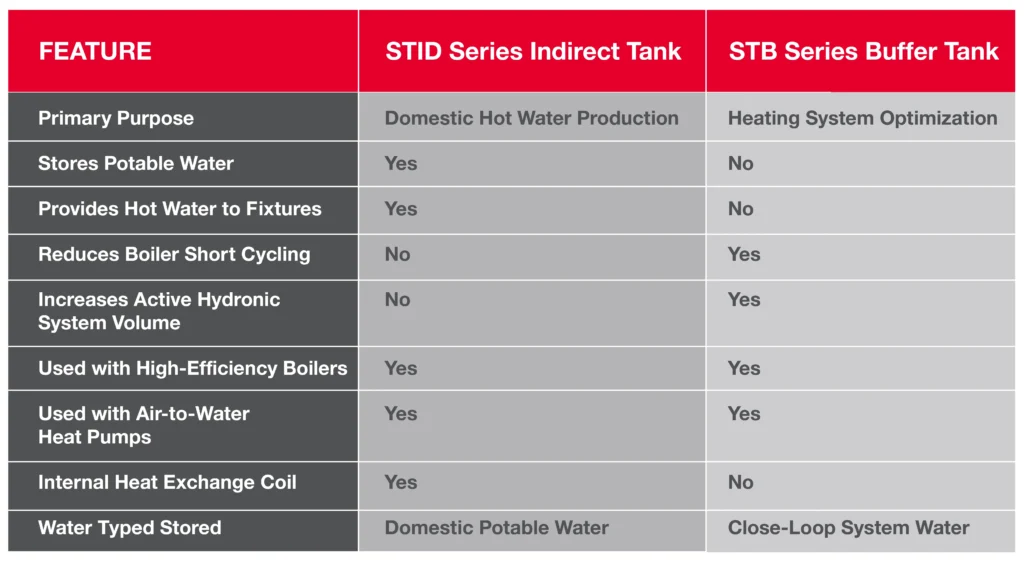
The Rheem® STID Series Indirect Tanks stores and delivers domestic hot water for showers, faucets, dishwashers, and laundry.
The Rheem® STB Series Buffer Tanks improves heating system performance by increasing system water volume and reducing equipment short cycling. It does not produce domestic hot water.
Rheem® STID Series Indirect Tanks
The STID Series Indirect Tanks are heated by a high-efficiency boiler to produce and store domestic hot water. Water from the boiler circulates through an internal stainless-steel coil, transferring heat to the potable water stored in the tank.
Key Benefits
- Provides high volumes of domestic hot water.
- Stainless steel tank and coil for corrosion resistance and long service life.
- Lightweight design for easier installation.
- Two inches of insulation help minimize standby heat loss.
Standard STID vs. STID MAX
For higher hot water demand applications, Rheem offers STID 80-MAX and STID 119-MAX models. These units feature larger heat exchanger coils and larger boiler-side connections, allowing more heat transfer and significantly higher hot water output.
Best Applications
- Schools
- Apartment buildings
- Hotels and Restaurants
- Luxury homes with large soaking tubs or multiple head showers
Rheem® STB Series Hydronic Buffer Tanks
The STB Series Hydronic Buffer Tanks are designed to improve the performance of hydronic heating systems. Rather than storing domestic hot water, it adds water volume to the heating system to help boilers and heat pumps operate more efficiently.
Key Benefits
- Reduces short cycling by increasing system water volume.
- Improves temperature stability under changing heating loads.
- Helps maintain proper water flow through heating equipment.
- Ideal for low-mass condensing boilers and air-to-water heat pumps.
Best Applications
- Multi-zone hydronic systems
- Boiler systems prone to short cycling
- Air-to-water heat pump systems
Side-by-Side Comparison
Can You Use Both Together?
Absolutely. In many high-performance hydronic systems, both tanks are used alongside a boiler.
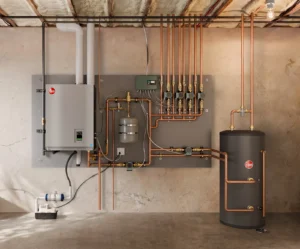
For example:
- Rheem FT Series Boiler provides the heat source.
- STID Series Indirect Water Heater provides domestic hot water.
- STB Series Buffer Tank improves heating system performance.
In this setup, the STID serves the people in the home, while the STB serves the heating system.
The Bottom Line
Choose a Rheem STID Series Indirect Water Heater when you need domestic hot water. For higher-demand applications, the STID MAX models deliver substantially greater hot water output thanks to larger heat exchanger coils and boiler connections
Choose a Rheem STB Series Buffer Tank when you need to improve hydronic heating system performance. By increasing system water volume, the STB Series reduces short cycling, improves temperature stability, and helps optimize efficiency.
Together, the STID and STB Series provide a complete solution for efficient heating and reliable hot water production.
Visit our Boiler Hub for more information or our product pages: