Warranties
  Rebates
  Tax Credits
  Sustainability
  Careers
  Help
Help 



When Is It Time to Replace Your Tankless Gas Water Heater? Lessons from Chip Wade’s RTG-R Upgrade
August 10, 2026
 Facebook
  X
X  LinkedIn
 Tankless gas water heaters are known for their long service life, reliable hot water, and energy efficiency. But even the best systems eventually reach a point where homeowners must decide whether to repair or replace. That was the decision faced by television host and home renovation expert Chip Wade when it came time to upgrade the three Rheem® RTG tankless gas water heaters serving his home.

A System That Delivered for Years
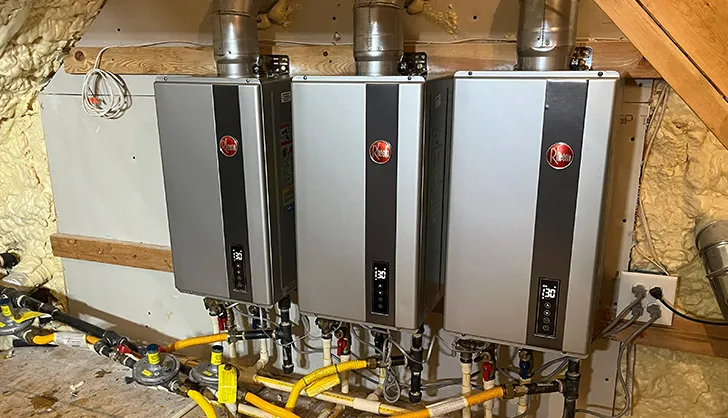
Chip’s original three-unit RTG tankless water heater system was installed when he built his home 14 years ago. The manifolded setup, paired with an external recirculation system, was designed to meet the demands of a seven-bathroom home with high simultaneous hot water usage.
After years of dependable performance, Chip decided to proactively upgrade from his existing RTG models to the newer RTG-R units while replacing his HVAC system. Rather than wait for an unexpected issue, he saw the renovation as the perfect opportunity to modernize his water heating system and take advantage of the latest Rheem® technology, including built-in recirculation capabilities and enhanced performance features.
Why Replace a Tankless Gas Water Heater That Still Works?
One of the most common questions homeowners ask is, “If my RTG tankless gas water heater is still working, why replace it with a RTG-R model?”
For Chip, the decision was driven by the age of the equipment and the opportunity to upgrade while other home improvements were already underway.
“The original water heaters were still working, but after 14 years and with other renovation work already underway, I felt it was the right time to be proactive,” said Chip Wade. “The new RTG-R units gave me the features I wanted—internal recirculation, Wi-Fi control through EcoNet®, and leak detection—while making the replacement process straightforward.”
Signs It May Be Time to Upgrade
Even if your tankless gas water heater is still producing hot water, there are several indicators that replacement may be the smarter long-term solution:
- Your unit is approaching the end of its expected service life.
- You notice recurring service calls or maintenance issues.
- The home’s hot water demands have changed.
- You want improved features and controls available on newer models.
- You are looking to modernize your home’s mechanical systems and avoid unexpected downtime.
A planned replacement allows homeowners to upgrade on their schedule rather than waiting for a complete system failure.
Inside the Installation
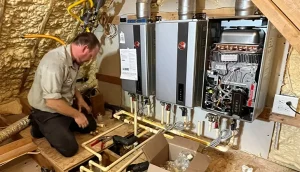
Because Chip was replacing an existing three-unit manifold system, the installation was straightforward and efficient. Despite the attic location, the RTG-R units’ lightweight, compact design made them easier to transport and position.
The installation team was able to reuse much of the existing infrastructure, including the manifold configuration and venting system. The cold-water connections aligned with the new units, and only minor modifications were needed to the hot-water piping. By leveraging the existing setup, the team upgraded the system with the latest technology while minimizing installation time and disruption to the home.
The Bottom Line
Tankless gas water heaters can provide years of dependable hot water, but eventually every homeowner faces the repair-versus-replace decision. Chip Wade’s upgrade demonstrates that replacement isn’t always driven by system failure. Sometimes it’s about taking advantage of newer technology, improving convenience, and making an upgrade on your own schedule.
If your tankless gas water heater is more than a decade old, experiencing recurring service issues, or you’re planning a major home renovation, it may be worth evaluating whether an upgrade makes sense for your home.